Everyone Wants Rail to San Diego’s Airport. But Which Alternative?

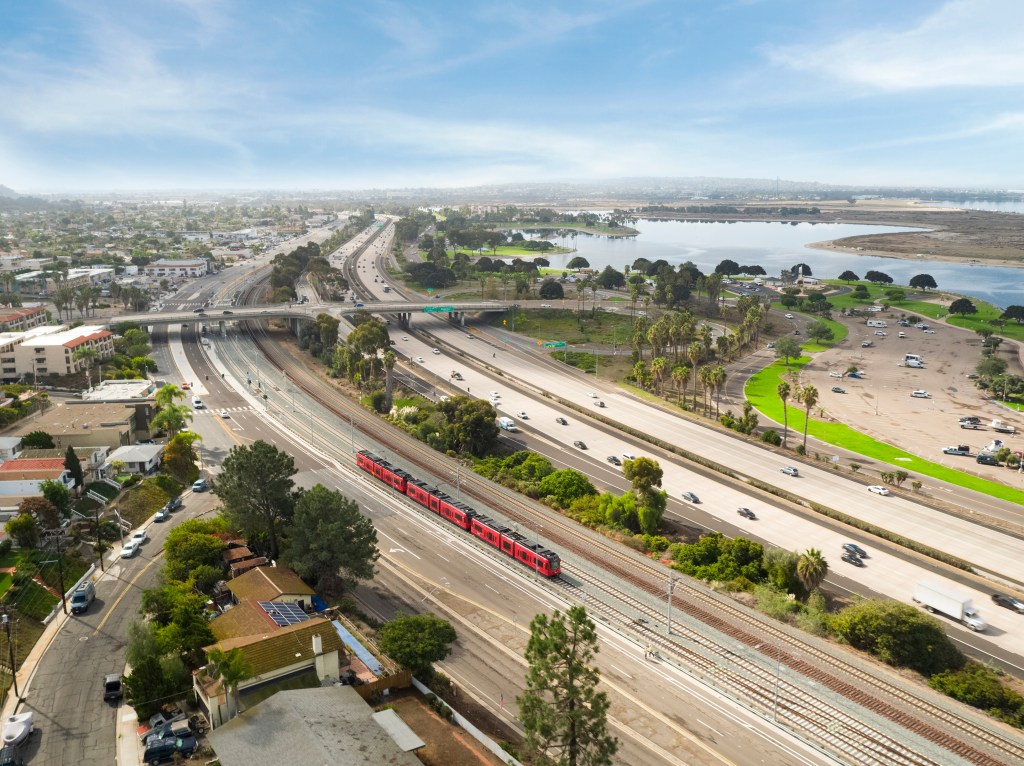
San Diego Union-Tribune Columnist Michael Smolens recently doubted whether San Diego needs an airport rail link.
While Smolens is wrong, his previous anti-airport rail naysaying has proved futile. The airport rail link has remained perennially popular among San Diegans, who thus need little convincing that airport rail is good.
Therefore, the question is not whether to build airport rail–even conservative exurbs support it. At SANDAG’s September 17 Transportation Committee, Trump Republican County Supervisor Joel Anderson proposed a subsequently-passed motion to fast-track airport rail. The question is, which airport rail alternative? RideSD prefers the elevated Automated People Mover (APM) because compared to the Airport Trolley, the APM would enable higher frequencies on both the Airport Rail Link and Blue and Green Lines. Unfortunately, SANDAG’s new Airport Rail study addendum downplays the APM’s advantages.
SANDAG’s Flawed Ridership Estimates
SANDAG’s addendum lists the APM’s maximum frequencies at 2 minutes versus 7.5 minutes for the Airport Trolley, because the Airport Trolley would introduce a physical bottleneck junction while the APM would not. Nonetheless, the same addendum forecasts ridership at 5,800 and 8,800 daily boardings for the APM and Airport Trolley respectively, assuming 7.5-minute frequencies for both.
7.5-minute frequencies sound decent until considering that APM trips between Santa Fe Depot and San Diego Airport would last only seven minutes. Consequently, passengers could spend as much time waiting for APM trains as they do riding them. Moreover, frequency is king because passengers perceive one minute of wait time as equivalent to 2-3 minutes of in-vehicle time. Thus, by projecting APM frequencies at 7.5 rather than 2 minutes, SANDAG is significantly underestimating APM ridership.
Perhaps SANDAG supposed 7.5-minute APM frequencies, assuming that even if MTS closed its $136M annual deficits and received additional funding to increase service, MTS could not afford to run the APM more frequently.
This fear is questionable. Any extra operating costs a 3.45-mile APM would have over the Airport Trolley would be tiny compared to the existing 65-mile Trolley Line’s operating costs.
SANDAG likely handicapped the APM’s frequencies to match the Trolley’s to make its ridership comparison “apples-to-apples,” though SANDAG’s capital cost comparison is not.
The APM’s Cost Advantage
For Concepts 6A and 9A (the cheapest Trolley and APM alternatives, respectively) SANDAG calculates per-mile capital costs at $787 million and $392 million.
However, these estimates misleadingly divide total costs for each alternative by total length rather than by new track length.
The Airport Trolley comprises 3.89 miles, including 2.04 miles of existing track, and will not require a new yard. Thus, all the Airport Trolley’s $1.516 Billion capital cost buys is 1.85 miles of new track and two new stations. Meanwhile, the APM’s $2.564 Billion cost includes not only 3.45 miles of new revenue track and five new stations but also 0.8 miles of non-revenue track plus a new Operations, Maintenance, and Storage Facility (OMSF). Resultingly, per mile of new track, the APM’s capital costs are cheaper than the Airport Trolley’s.
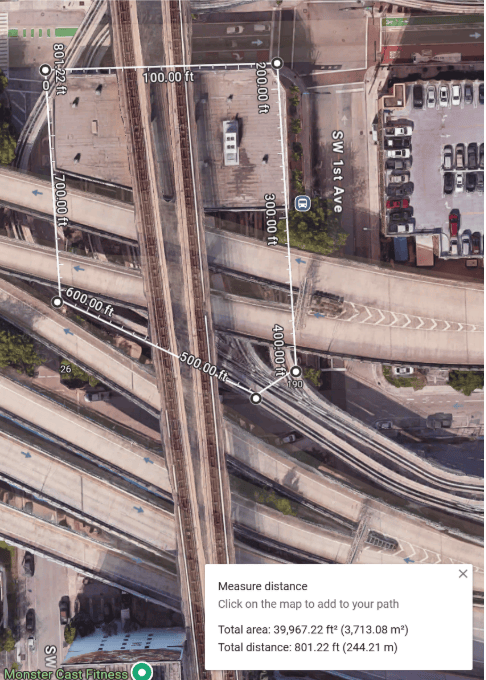
Encouragingly, SANDAG identified three compact, Downtown-adjacent APM yard sites, ranging from 3.16 to only 1.8 acres. Indeed, Miami’s 4.4-mile Metromover APM stores its entire 46-railcar fleet inside a single, one-acre Downtown yard, sandwiched between freeway and rail viaducts (below).
Furthermore, the elevated APM would have low construction complexity while even the cheapest Trolley alternative would have high complexity. APM skeptics may respond by citing LAX Skylink APM’s delays and exorbitant costs, but they have nothing to do with APM technology itself and everything to do with contractual quirks.
Moving Beyond “Rail-is-Good” Platitudes
Some transit advocates prefer the Airport Trolley because it is cheaper than the APM. The sentiment is, “build airport rail now! Do not let the perfect be the enemy of the good!”
By that logic, advocates were foolish to push for the faster, more frequent automated Sepulveda Subway over the cheaper monorail. After all, Sepulveda was going to get grade-separated rail anyways because even NIMBYs supported the monorail.
By that logic, we should stay silent when planners propose freeway-adjacent rail transit, because routing rail routes through more central areas increases cost and time.
Of course, spending more building a transit project does not always improve quality. For instance, tunneling the APM under wide streets is needlessly expensive. Instead, the APM should be elevated, which would save time and money while delivering identical speed, frequency, and capacity to an underground APM.
By contrast, spending more to build an APM that frees up Green and Blue Line capacity rather than an interlined Airport Trolley branch that further limits Green and Blue Line capacity is not extravagant; it is an upfront investment. Putting both the APM and Airport Trolley through environmental reviews will not delay the Airport Transit Connection because CEQA requires multiple alternatives for transit project reviews.
The Airport Trolley is better than no rail, but better than nothing is not good. If SANDAG discovers the APM to be technically impossible, then fine, build the Airport Trolley. Otherwise, let us pursue the best option: the elevated APM.

Streetsblog has migrated to a new comment system. New commenters can register directly in the comments section of any article. Returning commenters: your previous comments and display name have been preserved, but you'll need to reclaim your account by clicking "Forgot your password?" on the sign-in form, entering your email, and following the verification link to set a new password — this is required because passwords could not be carried over during the migration. For questions, contact tips@streetsblog.org.