Op/Ed: Prop 45 Isn’t Just a Highway Measure

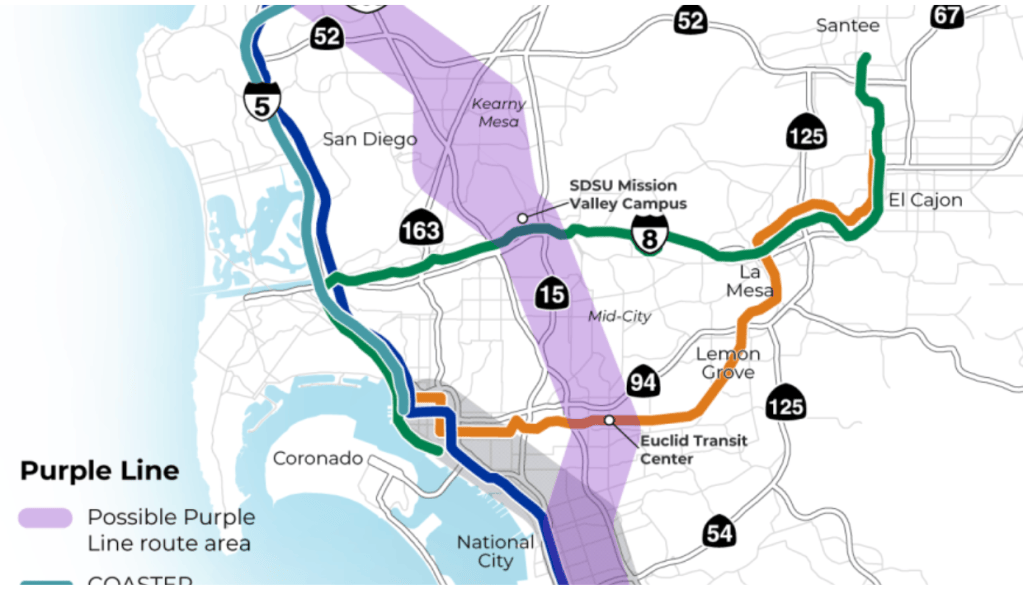
Prop 45 could decide how quickly San Diego builds the Purple Line, but most urbanist coverage hasn’t mentioned that. Instead, it describes the measure as little more than a highway and sprawl bill that does nothing for public transit and other urbanist priorities. Streets For All opposes it because, it says, train stations and many bike and pedestrian projects “aren’t covered by the measure’s narrow transportation language.” Streetsblog California objects that it speeds up highway expansions and argues that other transit, bike, and pedestrian projects are “already excluded from CEQA review.” Those arguments don’t fit together, and both are wrong. Prop 45 covers transit, biking, and walking, and it reaches the transit projects today’s exemptions don’t: those that need new right-of-way.
What Prop 45 covers
Prop 45 creates an optional fast track for “essential projects“: housing, from infill apartments to greenfield subdivisions; clean energy and transmission; water systems; transportation; medical treatment facilities; first responder facilities and wildfire risk reduction; broadband internet; and schools and colleges. It excludes jails and detention facilities, new oil and gas production, high-speed rail, and the Delta Conveyance Project. It doesn’t exempt any essential project from CEQA. Instead, it sets deadlines for environmental review and litigation, and fixed comment periods.
The downsides
I’ll start with the measure’s weaknesses. Prop 45’s transportation category covers “public streets and highways,” so a freeway widening could use the same fast track as a trolley extension. Housing isn’t limited to infill. A subdivision on the urban edge qualifies just like an apartment building near a trolley stop. And high-speed rail is excluded, which I think is a significant error by the drafters.
But Prop 45 doesn’t decide where housing or highways go. It “does not diminish the authority of any public agency to approve or disapprove an essential project,” and it doesn’t rezone any land. A city or county still decides whether to approve a subdivision. In San Diego, whether a freeway gets widened is decided largely in SANDAG’s Regional Plan and its funding choices. Highway work that uses federal money or needs federal approval, including most projects on the 5, 8, and 15, still needs federal environmental review, which for major projects requires a reasonable range of alternatives. Those are the places where the fights over sprawl and highways are won or lost, and where we urbanists should keep fighting them.
Prop 45’s litigation limits would apply to highway projects too. But even under current law, CEQA lawsuits often delay highway projects without necessarily stopping them. Two projects Streetsblog California describes as tied up by CEQA have since moved forward: in 2025, a court rejected the CEQA challenge to the I-80 widening across the Yolo Causeway, which is now under construction, and in 2026 the Court of Appeal ended a 15-year CEQA fight over Caltrans’ Richardson Grove project on US-101. The question is whether these costs outweigh what Prop 45 does for transit, infill housing, and clean energy. I don’t think they do, especially when Texas permitted about twice as many homes as California last year and has passed us in utility-scale solar capacity. As a born and bred Californian, I want my state to lead the country on these kinds of things, rather than letting CEQA hold us back while Texas (yes, oil and gas-loving Texas) runs circles around us.
Transit is covered
Prop 45 defines its transportation category by reference to Article XIX, Section 2 of the California Constitution. Subdivision (a) covers “public streets and highways (and their related public facilities for nonmotorized traffic).” That means bike lanes, sidewalks, and bike and pedestrian bridges. Subdivision (b) covers “exclusive public mass transit guideways (and their related fixed facilities).” That means trolley lines, subways, people movers, and their stations. Both subdivisions expressly include “the payment for property taken or damaged” for those purposes. The category is written with new right-of-way in mind.
Bus rapid transit is covered too. Bus lanes on existing streets are improvements to “public streets and highways,” the same category that covers new lanes for cars. In 1987, the Attorney General concluded that a separated bus-carpool transitway is part of “public streets and highways” under Article XIX. The Legislature takes the same view of streets: it lists “transit facilities” among the “complete street components” that cities and counties can build with SB 1 road money.
Why new right-of-way matters
Streetsblog California is right that many transit projects are already exempt from CEQA. SB 922 and its 2025 extension, SB 71, exempt a wide range of transit and active transportation projects. But the exemptions for transit lines apply only within existing rights-of-way. Bus, BRT, and light rail projects must sit entirely within an existing public or highway right-of-way in an urbanized area, and passenger rail within an existing rail or highway right-of-way. This could be make or break for viaducts and tunnels, which, along with their stations, portals, and yards, generally require acquiring new right-of-way. Projects costing more than $100 million also have to be included in a plan that underwent programmatic environmental review within the last ten years, and must complete a business case and racial equity analysis, and sometimes a displacement analysis. And the whole exemption expires on January 1, 2040.
Prop 45 has none of those limits. It applies whether a project uses existing right-of-way or needs new right-of-way, and it has no sunset. Covered projects get a 365-day deadline for a decision on an environmental impact report, fixed comment periods, and a 270-day limit on litigation, appeals included. A court can extend that limit by up to 90 days, so the maximum duration is about a year. As an attorney, I can tell you that resolving a lawsuit within a year is remarkably fast. CEQA cases often take several years once appeals are counted. Moreover, Prop 45’s litigation duration limits apply to lawsuits challenging CEQA exemptions, which today can still hold up projects for years.
These factors are crucial for major transit projects in San Diego. SANDAG’s planning study looked at building the Purple Line as a subway or a mix of tunnels and elevated tracks, more than 22 miles long and costing $20.7 billion to $27.2 billion, likely built in segments over decades. A project like that will almost certainly need new right-of-way for stations, portals, and yards (SB 71 doesn’t cover new yards), and much of it will probably be approved after SB 71 expires. SANDAG’s elevated people mover option for the airport, with new track, five stations, and a new storage facility, could face the same problem. Prop 45 would give those projects firm deadlines and limits on litigation that current law does not.
Don’t let the perfect be the enemy of the good
Comprehensive CEQA reform rarely makes it to the ballot. Prop 45 isn’t the measure I would have written. It should have included high-speed rail, and I would have preferred it treat highway expansion and greenfield subdivisions differently. But it would make building infill housing, transit, and clean energy faster and more predictable, including transit on new right-of-way that current law leaves out. Those are the things urbanists say we want. I hope San Diego urbanists will take another look and vote yes on Prop 45.
Zack Defazio-Farrell is an attorney with a background in land use law, the Treasurer of the YIMBY Democrats of San Diego County, and a co-founder of RideSD, a San Diego public transit advocacy group.