How Upgraded Bicycle Infrastructure Also Benefits Pedestrians

This article first appeared in Pedestrian Space in 2022. It was updated for republication.
On March 19, 2022, the City of San Diego opened 3.5 miles of bike, pedestrian, and traffic-calming infrastructure between Talmadge and University Heights along Meade Avenue and Georgia Street. At the time, I wrote about some of the benefits of the project, along with a few opportunities for improvement.
Orange and Central Avenue will extend many of the same ideas deeper into Mid-City, adding another 3.3 miles of bikeways and routes, along with traffic calming, safer crossings, expanded sidewalks, repaving, and other improvements. Central Avenue is expected to open in 2027, while Orange Avenue is expected to be completed in 2028. More importantly, they will begin stitching together a much larger network. Orange and Central will connect with existing and planned routes on Meade Avenue, Landis Street, University Avenue, the SR-15 Commuter Bikeway, 30th Street, Park Boulevard, Pershing Drive, and Fifth Avenue. In light of the recent groundbreaking for the Orange and Central Avenue Complete Streets Projects, I figured I’d revisit San Diego’s first proper bike boulevard.
While the centerpiece of the Georgia-Meade project is certainly the improved bikeway, the supporting design elements go a long way in providing comfort to the neighborhoods’ many pedestrians as well. The Mid-City and Uptown communities that this corridor runs through are dense mixed-use streetcar suburbs.
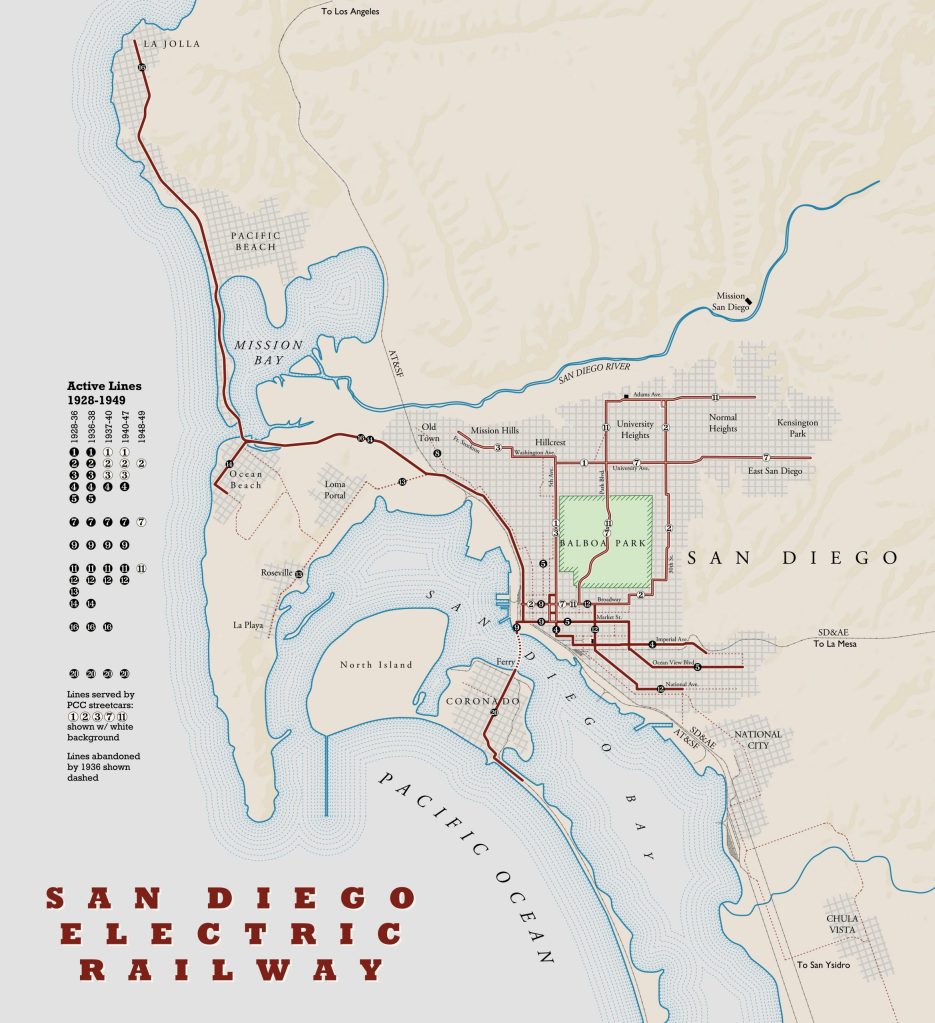
This makes it extremely walkable, allowing residents living along Meade Avenue to get to businesses and services along Adams Avenue and El Cajon Boulevard without having to get in their car. Along with businesses, there are a handful of parks, schools, and other cultural institutions that line the gridded streets intersecting these Mid-City neighborhoods. I frequently see friends strolling along with a cup of coffee, parents walking their children to school, or a couple in pajamas walking their little pup. These improvements benefit us all by calming traffic and reclaiming space.
Calming Traffic
Traffic calming is an important measure in improving pedestrian safety and comfort. For decades, North American traffic engineering relied heavily on speed limit signs as a way of slowing traffic. We now know that driver behavior is shaped much more effectively by the built environment. These principles are put into practice along the Georgia-Meade Bikeway and are also central to what is now being built on Orange and Central avenues.
Traffic calming is ultimately the core reason for why Meade is such a comfortable boulevard for cyclists and pedestrians alike. When vehicles are moving slow enough that bicyclists and pedestrians can comfortably share the street with them, the need for heavy physical separation becomes less significant. We see versions of this approach in cities around the world, where narrow streets, raised crossings, traffic circles, limited through-traffic, and other design features make relatively simple bicycle facilities work because drivers are forced to travel at safer speeds. Along Meade, and eventually replicated on Orange and Central, a number of small improvements work together to make this happen.
Traffic circles
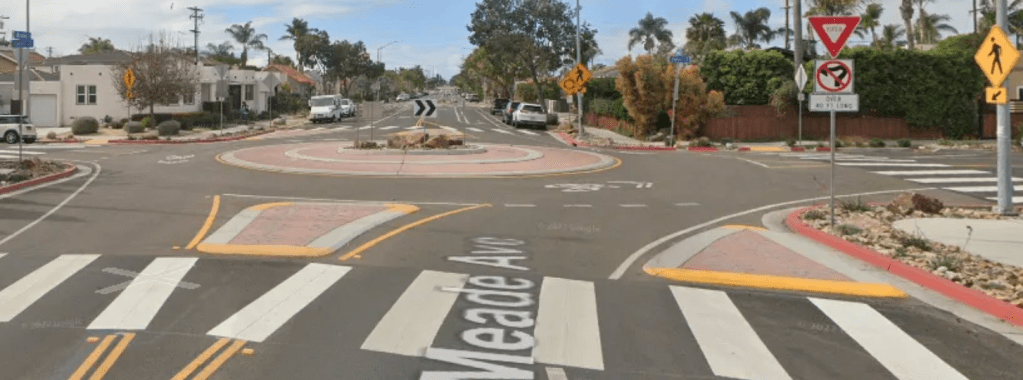
There are 10 new traffic circles, or roundabouts, throughout Meade Avenue. Roundabouts are great for many reasons: they improve traffic flow for drivers and bicyclists, decrease localized pollution, and force drivers to slow down, reducing both the likelihood and severity of crashes.
An added benefit of many of the roundabouts on Meade Avenue is that they have splitters and sidewalk extensions. These reduce pedestrian crossing distances and provide refuge so pedestrians can navigate traffic one direction at a time. Because they are slightly raised, they can also reduce the speed at which vehicles enter the roundabout.
Orange Avenue will include a new traffic circle along with median islands, curb extensions and raised crossings. Central Avenue will similarly incorporate traffic circles and intersection improvements as it connects neighborhoods east of Interstate 15.
Chokers
Chokers and speed cushions work in tandem to slow traffic. While the cushions slow vehicles, they allow emergency response vehicles to pass through relatively unimpeded. The chokers on either side help separate vehicles from bicyclists and pedestrians.
Though there are an acceptable number of speed cushions, nine across the entire bikeway, I would actually like to see a few more chokepoints given how residential a majority of this corridor is.
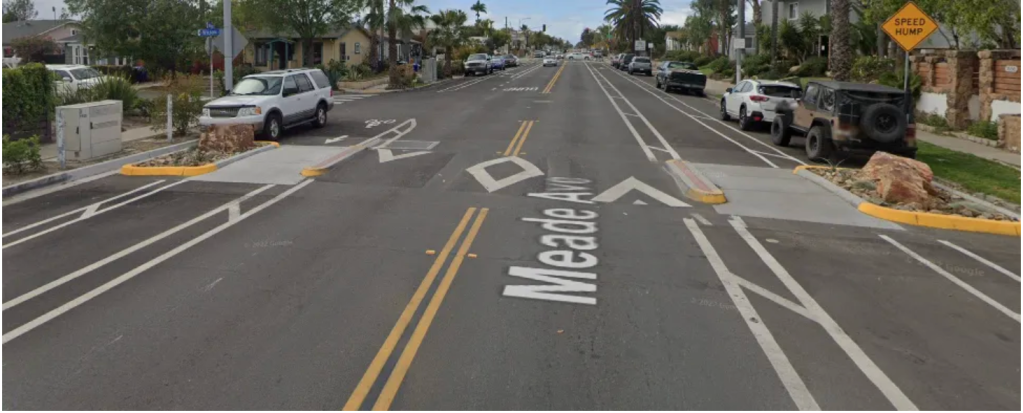
Raised crosswalks
Raised Crosswalks
Acting as an uninterrupted extension of the sidewalk, raised crosswalks communicate to drivers that they are passing through pedestrian space and need to accommodate higher-priority traffic.
There are three across Meade, with two placed next to an elementary school.
Raised crosswalks will also be incorporated into the new Orange Avenue and Central Avenue projects. Raised crosswalks represent an important change in how we think about the street: instead of asking pedestrians to continually descend into vehicle space, we can design intersections where vehicles physically enter pedestrian space and are required to slow down.
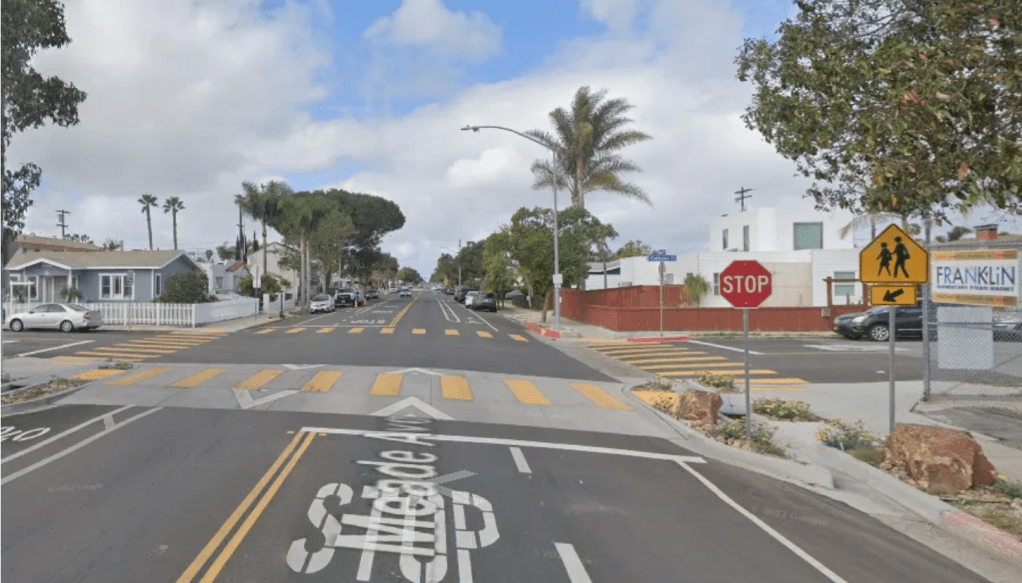
Bend-outs
These do three things really well:
- Extend the sidewalk, reducing crossing distance;
- Place crossing pedestrians ahead of stopped vehicles so they are immediately visible to drivers; and
- Force drivers to take right turns more slowly, reducing both the probability and severity of a vehicle-pedestrian collision.
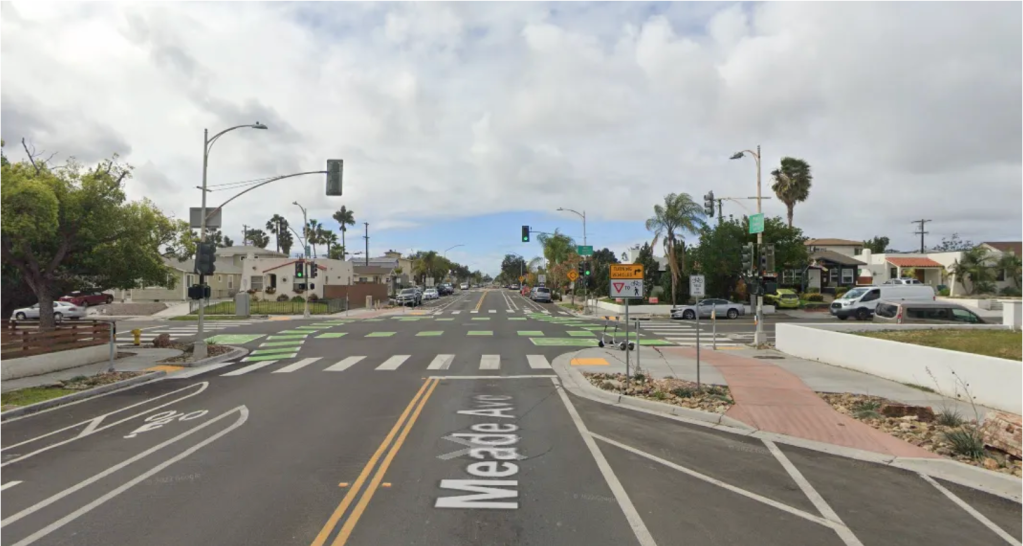
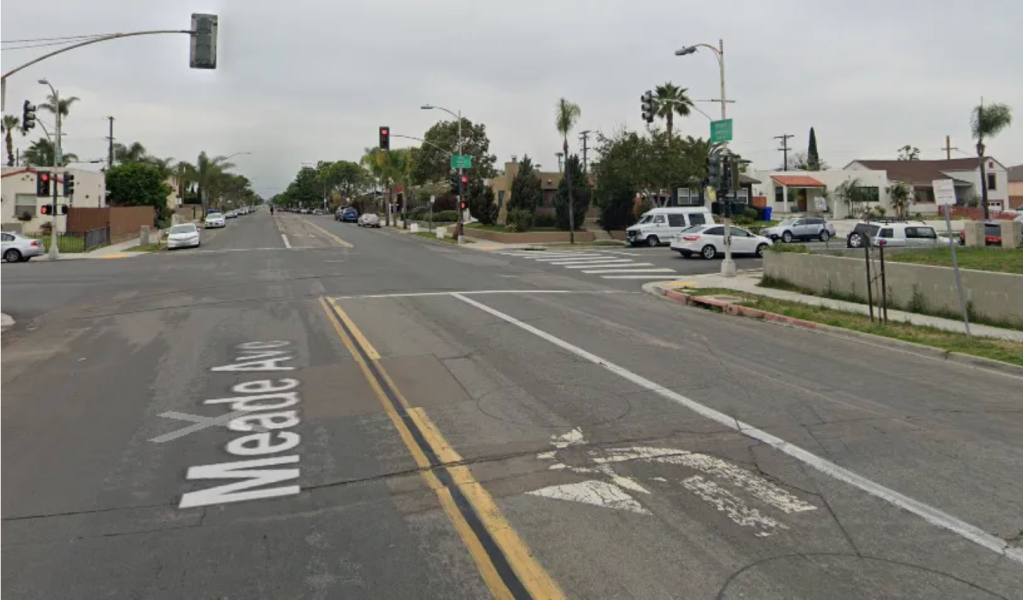
Buffered bike lanes
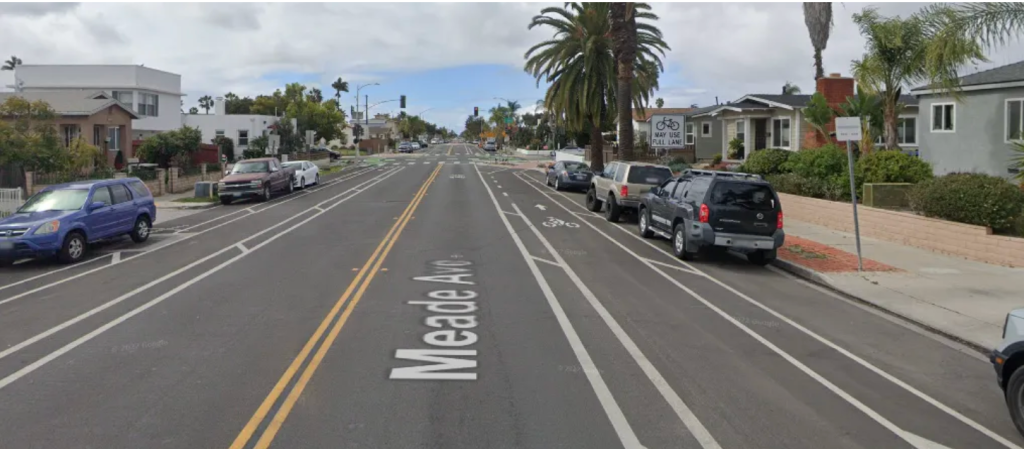
Even though paint isn’t infrastructure, guiding lines help keep vehicles within their lane. This, along with parked vehicles, street trees, traffic calming, and other design features, provides layers of separation between moving vehicles and people walking along the sidewalk.
Narrowed Roads
All of these upgraded design elements ultimately do a great job of narrowing the roadway throughout the corridor. Slapping a 35 MPH speed limit sign on a massive road may tell drivers what the legal speed is, but it does little by itself to force drivers to comply. If slowing traffic is our goal, slimming down roads is one of the most effective ways to do it.
Like Meade, Orange will largely rely on buffered bike lanes combined with traffic calming rather than continuous physical protection. The safety of the corridor will therefore depend heavily on whether the street itself communicates to drivers that lower speeds are expected.
Traffic Diverters
One of the most important additions to the Orange Avenue project will be median-island traffic diverters. These treatments require drivers to turn rather than continue straight through certain intersections, while still allowing people walking and biking to pass through. The goal is to reduce cut-through traffic on Orange Avenue, lowering both vehicle volumes and speeds and making the corridor more comfortable for people biking and walking. This is especially important on a bike boulevard, where the quality of the bikeway depends heavily on keeping motor vehicle traffic relatively slow and limited.
The diverters are also worth highlighting as a huge win in the overall design, advocated for by community leaders years ago, including City Heights CDC. Their advocacy helped shape Orange Avenue into a more complete neighborhood bikeway.
From a Bikeway to a Network
Perhaps the biggest difference between 2022 and today is that Meade is starting to look less like a standalone project and more like one piece of a system.
Orange Avenue and Central Avenue will help close gaps between Mid-City neighborhoods and existing routes on Meade, Landis, University, the SR-15 corridor and beyond. Combined with projects on 30th Street, Park Boulevard, Pershing Drive and Fifth Avenue, the urban core is slowly developing something San Diego has historically lacked: a proper network of bike lanes.
These investments are particularly important in Mid-City, which are not only the densest neighborhoods in the county but are also absorbing substantial amounts of new housing in the near future. As more people live within walking and biking distance of schools, parks, businesses, transit and one another, the transportation network needs to give them realistic alternatives to driving for every short trip.
Four years after Meade opened, some of its trees have grown, its traffic-calming treatments have become part of the neighborhood, and thousands of everyday trips have taken place through a street that looks and functions very differently than it did before. When Orange and Central are finished, the most important measure of their success won’t simply be how many miles of bike lanes were added. It will be whether a child can bike to school, a senior can comfortably cross the street, a family can reach a park, or someone can travel across Mid-City without feeling like getting into a car is their only reasonable choice. I look forward to riding it together.

Streetsblog has migrated to a new comment system. New commenters can register directly in the comments section of any article. Returning commenters: your previous comments and display name have been preserved, but you'll need to reclaim your account by clicking "Forgot your password?" on the sign-in form, entering your email, and following the verification link to set a new password — this is required because passwords could not be carried over during the migration. For questions, contact tips@streetsblog.org.